
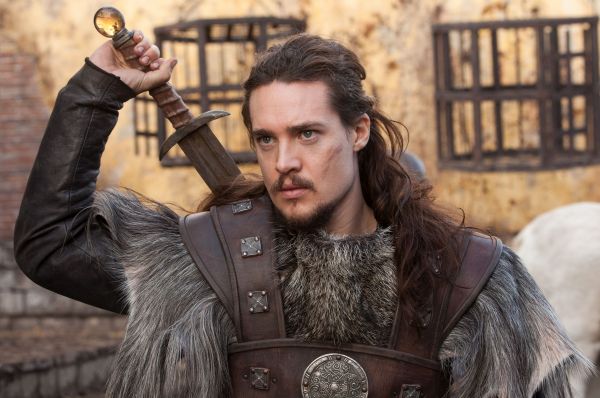
The television series, The Last Kingdom, is an exciting historical drama, but the way it treats the arc of protagonist Uhtred of Bebbanburg doesn’t measure up to the material.
Fishermen love a good fish story, especially the one that got away. I was hooked by the BBC America television series The Last Kingdom, but the hook is loosening and I may spit it out. Why? Because the writers made a huge narrative mistake. The protagonist doesn’t change.
Premiering in 2015, The Last Kingdom stars Alexander Dreymon as Uhtred of Bebbanburg, a dispossessed Saxon noble who fights, often reluctantly, for a united England envisioned by the ninth century king of Wessex, Alfred the Great. The series is based on novels by Bernard Cornwell, who counts the historical Uhtred as an ancestor.
I’m halfway through season two, but I’m fast losing interest. It’s too bad, because this historical drama dives deep into each of its characters, from the intelligent, fearless warrior Uhtred to the pious, visionary Alfred. Each of the series’ minor characters are multi-dimensional, all fully fleshed by uniformly good performances. With a forceful plot driven by internal court intrigue and external enemies—the Viking raiders that still frighten English children—The Last Kingdom presses all my buttons.
The protagonist stumbles
Possible spoilers ahead.
Unfortunately, the series stumbles badly in episode three, when Uhtred returns after an enemy in an allied camp has him seized and sold as a slave. After six months as a galley slave a la Charleton Heston in Ben Hur, Uhtred is broken in body and nearly in spirit.
Herein lies the rub. One of the great joys of reading and watching fiction is seeing how a protagonist changes over time. How do his experiences within the story change him? What does he learn? This mimics the normal growth of most people; I’m not the same person I was twenty years ago, due in part to my unique experiences as a worker, a husband, a parent, and as a writer. Good fiction compresses this universal process.
Nothing comes of the pain
In The Last Kingdom, Uhtred goes through a horrific experience as a slave. Up to this point, the character of Uhtred is predictably immature and self-serving. By the time he returns, he has lost virtually all his dignity as a man and a nobleman, feels responsible for the death of a companion, and is nearly handed over to his ultimate enemies, the Danes. His recovery is slow and painful, physically and emotionally. He is the biblical Jonah after the whale vomits him out.
The experience poses fascinating questions, broad and narrow. What happens to your personality when abuse is routine and escape from captivity is out of reach? Will Uhtred understand how his womanizing hurts himself as well as the women he’s lost? Will he see that theft as a way of gaining wealth invites deadly retribution? How does this experience affect his view of life?
The answer: Not at all. A short time after his rescue from the slaver, Uhtred kills the man who orchestrated his betrayal. It’s a murder that shocks everyone, except Uhtred. Even if he hadn’t been sold into slavery, Uhtred might kill his enemy, because that’s what he does. It’s who he is. What’s more, he resumes his former life without offering the audience any reflections on his experience or more importantly, change in his behavior. No reference is made to the experience in succeeding episodes; Uhtred is the same warrior who fears nothing, chafes at his obligations, and acts almost entirely out of self-interest.
Trauma, but no damage
It’s hard to believe that a human being could go through six months of degradation without some damage that affects how he lives afterward. It’s a scenario for hopelessness, suggesting humans are forever trapped by their own prejudices and habits, and not even a daily brush with death can alter the course of a life. While one could argue this reflects real life, it makes for a disappointing narrative, because nothing emotionally substantive has changed after 11 episodes. A viewer could almost turn from liking Uhtred to not liking him, and perhaps abandoning him. Protagonist change is essential to maintaining connection to the character.
I have a few more episodes to go, and the producers could still redeem themselves with Uhtred showing that he is not the same man he was when he lost his family in the early episodes of season one. If he doesn’t, I’m not sure I’ll make the time to see how he fares in season three.
What’s your take on The Last Kingdom?
One response to “Protagonists must grow: What happens when they don’t?”
[…] the reader confused at first, but anxious to learn how Banks’ deals with a death. As the protagonist works through the language problem, we see how it influences her perceptions and changes her […]