
Many science fiction writers overlook Earth’s environmental issues; Bacigalupi’s The Windup Girl exemplifies eco-fiction addressing climate change and genetic manipulation.
It’s too bad more science fiction writers don’t address changes to Earth’s environment. Most are interested in the environment of other planets, while our home world’s atmosphere and biosphere grow more alien every day. Thank God for writers such as Margaret Atwood, with her Maddaddam Trilogy, Emmi Itäranta, author of The Memory of Water, and the late George Turner, whose The Sea and Summer anticipated the emerging eco-fiction genre by a generation.
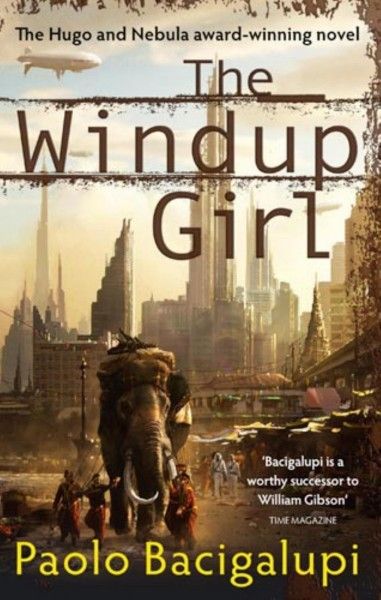
Add to these Paolo Bacigalupi and The Windup Girl, which won the 2010 Hugo Award for Best Novel. Critics and marketers who insist on genre-izing everything have labeled it “biopunk,” a story taking humanity’s ten-thousand-year-old penchant for tinkering with biology to logical, if not absurd, commercial and scientific extremes. Writers fiddling with stories about climate change or GMO foods ought to look to The Windup Girl for lessons in how to approach these issues.
A near-future, post-carbon Bangkok
Bacigalupi imagines a relatively near-future post-carbon Bangkok where the leaders of the Environment Ministry and the Trade Ministry vie for political primacy. Planet-wide, humanity has survived an economic calamity brought about by the depletion of oil. The world is climbing out of the disaster, but the institutions of capitalism and government are little changed. It’s still all about money and power, only this time the fight is over control of bioengineered foods and alternate energy sources. The nightmare scenario of GMO paranoiacs–that man-made genes will supplant mother nature’s–has come to pass with devastating results. And a legacy of a world warmed by CO2–higher sea levels–is poised to kill the city like the sword of Damocles.
As fiction, The Windup Girl plays down the monster scenario, despite the cruel truth of viruses overwhelming public health systems (the current Ebola outbreak) and global-warming-enhanced megastorms destroying major cities (e.g. Katrina and New Orleans). The closest Bacigalupi comes is the eponymic Windup Girl, Emiko, an engineered human-like creature with an anger-management problem. Fortunately, she’s just one of many interesting characters, rather than the Grendel to be slayed.
Exploring deeper themes
Bacigalupi’s deeper themes focus on whether values will change (or not) as people acquire new genetically modified options and stare at new environmental realities. A lazy reader would call the author’s answer dystopian, but anyone with a jaundiced view of Wall Street’s motives and the impacts of globalization will judge the rapacious behavior of The Windup Girl’s multinational corporations as only mildly exaggerated.
The strength of eco-fiction vis-à-vis other types of science fiction is how closely it can anticipate reality. Faster-than-light travel and encounters with alien beings may be fun to imagine, but they’re unlikely in the near term. Though no one has proven widespread ecological damage from genetically engineered plants or animals, the Monsantos of the world have won court cases against farmers practicing ancient traditions of seed-saving.
Sea levels are already rising, as are global temperatures, and it’s a small leap from today’s early effects of warming to an Earth where the ice caps are gone and oceans flood protected cities, such as London or Venice. As speculation, The Windup Girl is probably as close to predictive as you’ll find.
My other reviews can be found on this page. Which author would you add to the eco-fiction list?
10 responses to “Review: Paolo Bacigalupi’s ‘The Windup Girl’ read as eco-fiction”
Joe, I so wanted to like Windup Girl. I loved the concept. Loved the elephant/spring-powered factories: what a great idea. But the way the author treated the Windup Girl character turned my stomach: not that her life was so awful (that happens), but the voyeuristic glee he seemed to feel in watching that awfulness. It was too much for me and I had to stop reading.
PS. You might like Annabel Smith’s new book, ‘The Ark’: my review is here https://www.goodreads.com/review/show/1043835947
I’ll check it out. Thanks!
I can understand your point. I don’t know where you stopped in the story, but Emiko does get her revenge, which has a far greater impact than you might imagine. I’d encourage you to pick up the book again.
OK, I’ll give it another go.
[…] of an Australia flooded by rising seas is echoed by Paolo Bacigalupi’s Bangkok in his 2010 novel The Windup Girl. The Thai capital is kept alive by dikes and gates reminiscent of the Thames Barrier in […]
[…] Trexler and others cite the first novel with global warming as its central theme as J.G. Ballard‘s 1962 The Drowned World, which describes a Britain submerged by rising seas caused by sun-driven heating. From then on, the bulk of novels with climate change at least in the background are either thrillers such as Werner Herzog’s Heat and Clive Cussler’s Arctic Drift or science fiction and speculative fiction, such as George Turner’s The Sea and Summer and Paolo Bacigalupi’s The Windup Girl. […]
[…] Water Knife lacks the charm of Bacigalupi’s Hugo Award-wining The Windup Girl, with its genetically engineered elephants, spring-wound tech, and reverence for the Thai culture. […]
[…] The Windup Girl (Paolo Bacigalupi) — Climate change is one piece of a fascinating story Paolo Bacigalupi sets in a future Bangkok. […]
[…] of Water is described in some quarters as science fiction or speculative fiction. Itäranta writes for a teen audience (“young adult” in the publishing trade), but her book […]