
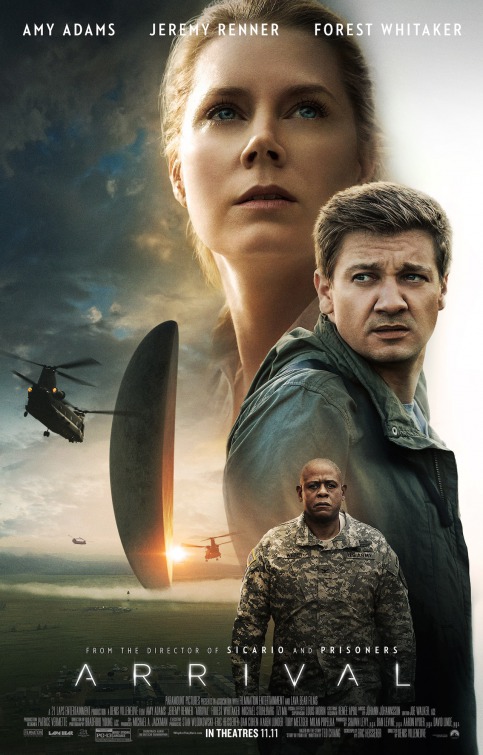
Ted Chiang’s “Story of Your Life” and its film adaptation “Arrival” explore time perception through non-linear storytelling, showcasing how language alters consciousness and perception, ultimately revealing alternative views of time.
We rarely think about our relationship with time. Life is just one damned thing after another. One word follows another. Cause and effect follow the arrow of history. What if you had a different relationship with time, one in which you perceived past, present and future happening at once, so that you know the future in the same instant you know the present and the past?
Science fiction writer Ted Chiang explores the idea in a 1999 short story, “Story of Your Life.” In 2016, Canadian Director Denis Villeneuve adapted the story for the motion picture Arrival, which arrived in theaters November 11. Both stories are told through the eyes of Dr. Louise Banks, a linguist brought in by the military to translate the language of aliens visiting the earth. The film builds on the short story, adding some Hollywood pizzazz and a different ending. Fortunately, the additions don’t obscure the main point; our daily experience of time is only one of many possibilities.
Language rewires the brain
In both narratives, a new kind of language “rewires” Banks’ brain, and the writer and director use non-linear storytelling as a way to demonstrate Banks’ transformative encounter. Non-linear stories don’t follow most people’s experience of events in time, that is, one thing following another as you walk a path through life. Sometimes called “disruptive narratives,” these stories jump around in time, as in Kurt Vonnegut’s Slaughterhouse-Five or Joseph Heller’s Catch-22. If handled poorly, non-linear stories leave readers confused and disoriented. Handled well, they seem more like paintings, best encountered as a whole.
Chiang’s text mixes future and past from its beginning, leaving the reader confused at first, but anxious to learn how Banks’ deals with a death. As the protagonist works through the language problem, we see how it influences her perceptions and changes her life.
Villeneuve, meet Chiang
Villeneuve accomplishes as much as Chiang, using a film technique similar to Quentin Tarantino’s in Pulp Fiction. The Canadian Villeneuve, who helmed last year’s Sicario, bends to Hollywood expectations, adding extra characters and threats to jack up the tension. Fortunately, screenwriter Eric Heisserer offers a more satisfying, if conventional, motivation for the aliens’ visit than Chiang, and the story’s outcome makes the film a nice complement to the short story.
Filmgoers hoping for a shoot-em-up aliens vs. humans picture will be disappointed. Villeneuve’s pacing is steady, almost meditative, reflecting the slow dawn of Banks’ new consciousness. It may also take a reading of Chiang’s story to fully grasp what happens to her. Taken together, Arrival and Story of Your Life will open your mind to other possibilities of perceiving time.
How would you rate Arrival?
2 responses to “Aliens, linguistics, and disruptive storytelling make Arrival must-see sci-fi”
[…] release of the movie Arrival last month prompted my interest in Seattle science fiction writer Ted Chiang. He has published only […]
[…] who invites him and other influential operatives and environmentalists on a month-long trip to the Canadian wilderness. Christianson hopes to reconnect them to their passion for the Earth through an […]