
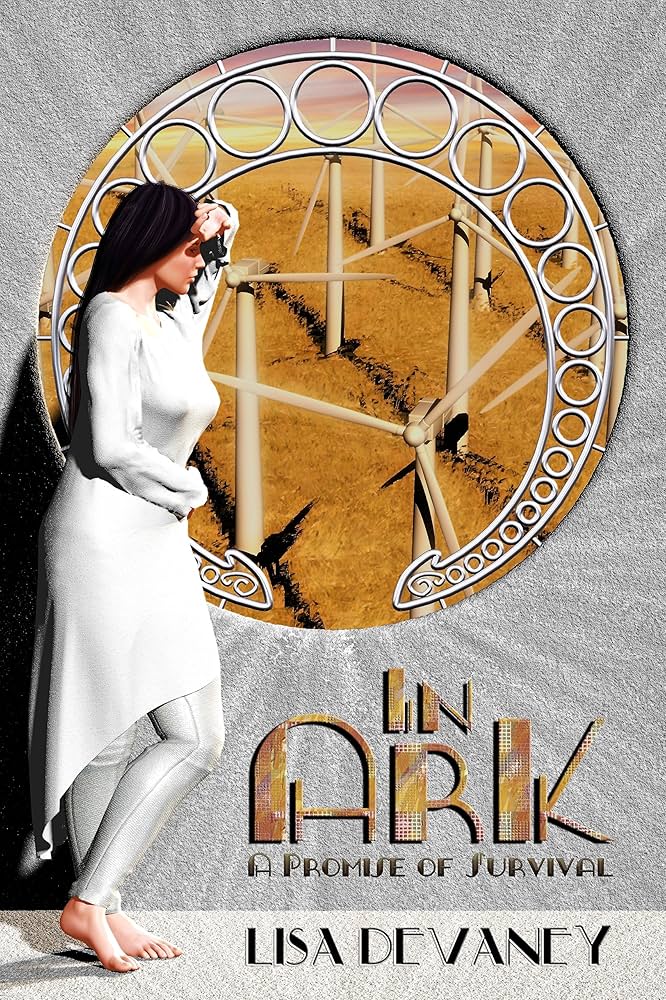
Climate fiction explores dystopian futures shaped by climate change, with Lisa Devaney’s “In Ark” illustrating the dangers of isolationist ideologies.
Most books in the emerging genre of “climate fiction” fall under the label after the fact. Margaret Atwood, author of the Maddaddam trilogy, has embraced the “cli-fi” label, though she prefers “speculative fiction.” Climate activist and book lover Dan Bloom and editor Mary Woodbury have attached the label to dozens of books published as early as the 1960s. In contrast, London-based author Lisa Devaney’s In Ark: A Promise of Survival, is one of the earliest works to adopt the term up front as a way for readers to identify its dystopian worldview and ideological themes.
The story follows the core rule of climate fiction, that is, climate change is the driving force behind the narrative. In 2030, digital archivist Mya Brand lives in a New York City where everyone must wear protective clothing against heat that is destroying the planet. Though fresh food is scarce, and social life happens literally underground, the irrepressible culture of New York thrives. But the overall social trend is downward.
‘Visionaries’ create ‘arks’
In most dystopias, extremists either threaten to overturn the social order, or they turn inward to escape the inevitable social implosion. In Devaney’s version, a group of wealthy individuals called the Visionaries create a number of colonies called “Arks,” which are self-contained communities intended as refuges for selected individuals.
One of these colonies operates in a remote area of Long Island, New York, growing its own food and subsisting on wind power. Ark agents scour the outside world for candidates to perform certain jobs, and Mya is kidnapped by a squad and taken to the Long Island facility.
Emotionally vulnerable after a failed marriage, Mya’s defenses against the persuasive powers of Ark and its leader, Randy, are thin. Mya’s identity is tied to her work, and Ark ensnares her when she is given nearly unlimited resources. But she learns the cost after a drug-enhanced sexual encounter leads to the realization that her body is not her own in Ark.
A warning about climate change
Though Mya’s rescue depends on an unconvincing coincidence, her experience in Ark shows that even the most benign ideology, in this case, living “sustainably” in isolation from the dominant culture, is as insidious and hypocritical as any malignant set of ideas. In Ark serves as a warning to a society that faces serious dangers as the climate changes. We won’t find answers by withdrawing into a cocoon of dogma.
Here’s a page listing all my book and movie reviews.
12 responses to “Review: Lisa Devaney’s ‘In Ark’ warns against a benign eco-ideology”
Awesome review 😀 It was really wonderful working with Lisa on this cover 😀
Great review Joe and I really value your insight. As I’ve never written a book before the views of published authors and talented writers is really important! Sharing this everywhere I can!
Thanks Joe, I’m looking forward to reading this new work. Your review has introduced me to this genre I’ve had no experience with. Lisa (my daughter), has amazing creativity and has spoken often throughout her life of someday writing a book. Your help is greatly appreciated, she’s a very special person! Joan Mummery
I’m so glad that I’ve helped you discover a new genre. Enjoy!
Thanks MOM! 🙂
Great job Aidana! Getting some flattering feedback about the cover and the art deco style font!
[…] Read his full review here. […]
[…] The first review I got was from the writer Joe Follansbee who talked about how my book warns against benign eco-ideologies. See his full review here. […]
[…] why my cli-fi book caught author and journalist Joe Follansbee‘s attention in his review about how “In Ark warns against benign […]
[…] Lisa Devaney: In Ark: A Promise of Survival (2014) […]
[…] In Ark (Lisa Devaney) — Author Lisa Devaney was one of the first independent authors to actively label her work climate fiction, and In Ark reminds us that ideologists often have hidden agendas. […]
[…] Lisa Devaney: In Ark: A Promise of Survival (2014) […]