
Lost museum ships represent irreplaceable pieces of America’s maritime past, with World War II ship museums particularly vulnerable. These vessels once preserved our naval heritage from World War II and beyond, but many have succumbed to age, neglect, and insufficient funding over recent decades.
Since the year 2000, the nation’s maritime history has eroded. The glamour gals–battleships Missouri and Iowa, carriers Midway and Intrepid, and a few more–along with hundreds of other vessels of all types, military and commercial, preserve the country’s memory of wars and hard work in dozens of ports and city waterfronts. But a number of these World War II ship museums and other historic vessels have been lost over the past quarter century for a variety of reasons: age, neglect, lack of money, and public disinterest.
Let’s revisit 16 of those lost museum ships, so that the sailors and mariners who once made the ships alive with activity won’t be forgotten. These losses represent not just individual vessels, but pieces of our naval heritage from World War II and beyond.
See photos of all these ships here.
Warships
USS Clamagore
USS Clamagore (1945-2022) – Commissioned just after the end of World War II, Clamagore was a Balao-class submarine converted to the GUPPY III type and serving during the Cold War. Decommissioned in 1975, she was acquired by the Patriots Point Naval and Maritime Museum, where she was displayed until 2022, when severe hull deterioration forced the museum to scrap the vessel. Though selected artifacts were preserved, she lost her National Historic Landmark status in 2024.
USS Cabot
USS Cabot / Dedalo (1943-2002) – The Independence-class light aircraft carrier USS Cabot (CVL-28) earned nine battle stars and a Presidential Unit Citation for her World War II service. This important piece of World War II naval heritage was decommissioned in 1947, but she was later recommissioned until 1955, when she ended her service as a training vessel. Loaned to Spain and renamed Dedalo, she was returned to the US for preservation as a museum ship in New Orleans. Plagued by financial and legal problems, she was auctioned off in 1997 and scrapped. Once a National Historic Landmark, parts of her survive in museums.
USS Inaugural
USS Inaugural (1944-1993) – Launched in Washington State, USS Inaugural was an Admirable-class minesweeper that earned two battle stars for service in World War II. Decommissioned in 1946, she found a second life as a museum in St. Louis, where she was moored near the Gateway Arch. In 1993, a flood on the Mississippi River pushed her off her dock and sank her. Declared a total loss, her National Historic Landmark status was withdrawn in 2001. Remnants of her can still be seen today near the bridge where she ended her career.
USS Ling
USS Ling (1945 to present) – Commissioned in the last months of World War II, USS Ling (SS-297) is a Balao-class submarine that never saw combat but served briefly before her decommissioning in 1946. After a long career as a training vessel, the navy donated her to a New Jersey non-profit. However, Hurricane Sandy damaged the site where Ling was docked. In 2018, vandals sank the boat, wrecking her interior. Supporters managed to refloat Ling, but she has languished ever since. She will likely never host another public visitor.

Commercial vessels
Bali Hai
Bali Hai (1943–?) – Originally built as a crash boat rescuing downed fliers in World War II, Bali Hai was converted after the war into a private yacht and operated as a charter vessel in Hawaii and California. In her final years, she was moored in Kauai, Hawaii, where the owners found themselves in a number of legal disputes. After years of neglect and a failed preservation effort, the boat sank at its moorings in 2001. Its ultimate fate is unclear.
Bounty
HMS Bounty (1960-2012) – The story of the replica of HMS Bounty includes one of the great modern tragedies of the tall ship community. Commissioned as a working set for the 1962 film “Mutiny on the Bounty,” starring Marlon Brando, she also appeared in the 2003 Johnny Depp movie, “Pirates of the Caribbean”. When not sailing for Hollywood, Bounty trained tall ship sailors, visited tall ship festivals, and took tourists on day sails. She was lost on October 29, 2012 off Cape Hatteras, North Carolina, during Hurricane Sandy. Two crew, Captain Robin Walbridge and Claudene Christian, a descendant of the famed Fletcher Christian, lost their lives.
Elisa Ann Conners
Elisa Ann Conners (1881-2023) – Launched in 1881 as a steam-powered tug, Elisa Ann Conners was refitted with a two-stroke diesel engine in the 1940s. She served on the Erie Canal before sinking in 1980; She wasn’t salvaged until 1993. Despite a valiant effort at restoration, money fell short and she was hauled out for scrapping in 2023.
Equator
Schooner Equator (1888-2023) – Neglected in a shed on the Everett, Wash., waterfront for decades, the schooner Equator once carried the writer Robert Louis Stevenson from Honolulu to the Gilbert Islands in the South Pacific. Listed on the National Register of Historic Places, the remains deteriorated until port officials finally gave notice that they would break up the schooner. After documenting the artifact, workers dismantled her in 2023.
Kalakala
Ferry Kalakala (1935-2015) – Launched in 1935 as a car ferry, Kalakala featured a unique art-deco design that charmed passengers and gave her captains daily headaches, because they couldn’t see her bow when docking. She carried Seattleites across Puget Sound for more than 30 years until she was retired in 1967. After spending time in Alaska, preservationists brought her back to Seattle for restoration. But plans came to nothing due to lack of permanent moorage and money. The vessel was sold at auction to another preservationist, but plans fell through, and the vessel was condemned to the wrecker’s yard in 2015.
Kula Kai
Kula Kai (1947–2011) – Built in Honolulu by boatbuilder Seichi Funai, Kula Kai was an aku sampan, a distinctive wooden fishing boat designed for deep-sea tuna fishing. She operated out of Kewalo Basin before the US Coast Guard determined her unseaworthy in 2011. Ownership transferred to a local non-profit, but funds never appeared for a restoration and she was broken up.
Pelican
Pelican (1992-2004) – Intended as a floating museum in Montreal, Pelican was launched in 1992, a replica of a French warship which defeated three English ships at the Battle of Hudson’s Bay. It was sold to a Louisiana company in 1995 and relocated to New Orleans, then Donaldson, La. In 2002, it sank at the dock, was refloated, and sank again after it was struck by a tugboat in 2004. It was abandoned to the Mississippi River.
Pilgrim
Pilgrim (1945-2020) – Originally built in Denmark as a Baltic trading schooner, Pilgrim was re-rigged as a brig in 1975 to resemble the 1825 merchantman made famous in Richard Henry Dana’s classic story, Two Years Before the Mast. From 1981, she worked in Dana Point, California as a floating classroom, appearing in the 1997 film “Amistad”. On March 29, 2020, Pilgrim keeled over due to hull failure. The owners declared her unrepairable and the vessel was demolished.
Tradewinds Kingfisher
Tradewinds Kingfisher (1941–2013) – Built in 1941 just before the start of World War II, the charter fishing vessel was offered to the Coast Guard for patrolling the Oregon coast. After the war, she escorted tourists around the waters of Depoe Bay, and she earned a spot on the National Register of Historic Places. Retired in 2000, she was donated to a local historical society, but mounting costs and a lack of public support led to her demolition in 2013.
SS United States
SS United States (1952 to present) – Though technically not lost yet, the luxury liner SS United States will likely end up at the bottom of the Gulf of Mexico as a habitat for fish and an attraction for divers. Launched in 1952, the iconic vessel was the fastest ever to cross the Atlantic, earning the Blue Riband on her maiden voyage. Designed by William Francis Gibbs, she hosted celebrities and presidents just as airliners began to supplant sea travel as the preferred means to reach Europe. Retired in 1969, she languished in Philadelphia while supporters hoped to turn her into a museum. Those efforts failed, and in 2025, she was sold and towed to Florida, where she awaits her final fate.
Wapama
Steam schooner Wapama (1915 – 2013) – Constructed in Oregon, Wapama entered service as a lumber, cargo and passenger schooner along the west coast. In 1958, the owners intended to scrap the vessel, but a group of San Francisco preservationists organized to save the ship as important to local history. The ship opened as a museum at the city’s maritime historical park, but she soon developed serious leaks. Eventually stored on land, further preservation efforts never jelled, despite being named as a National Historic Landmark. The boat was dismantled in 2013.
Wawona
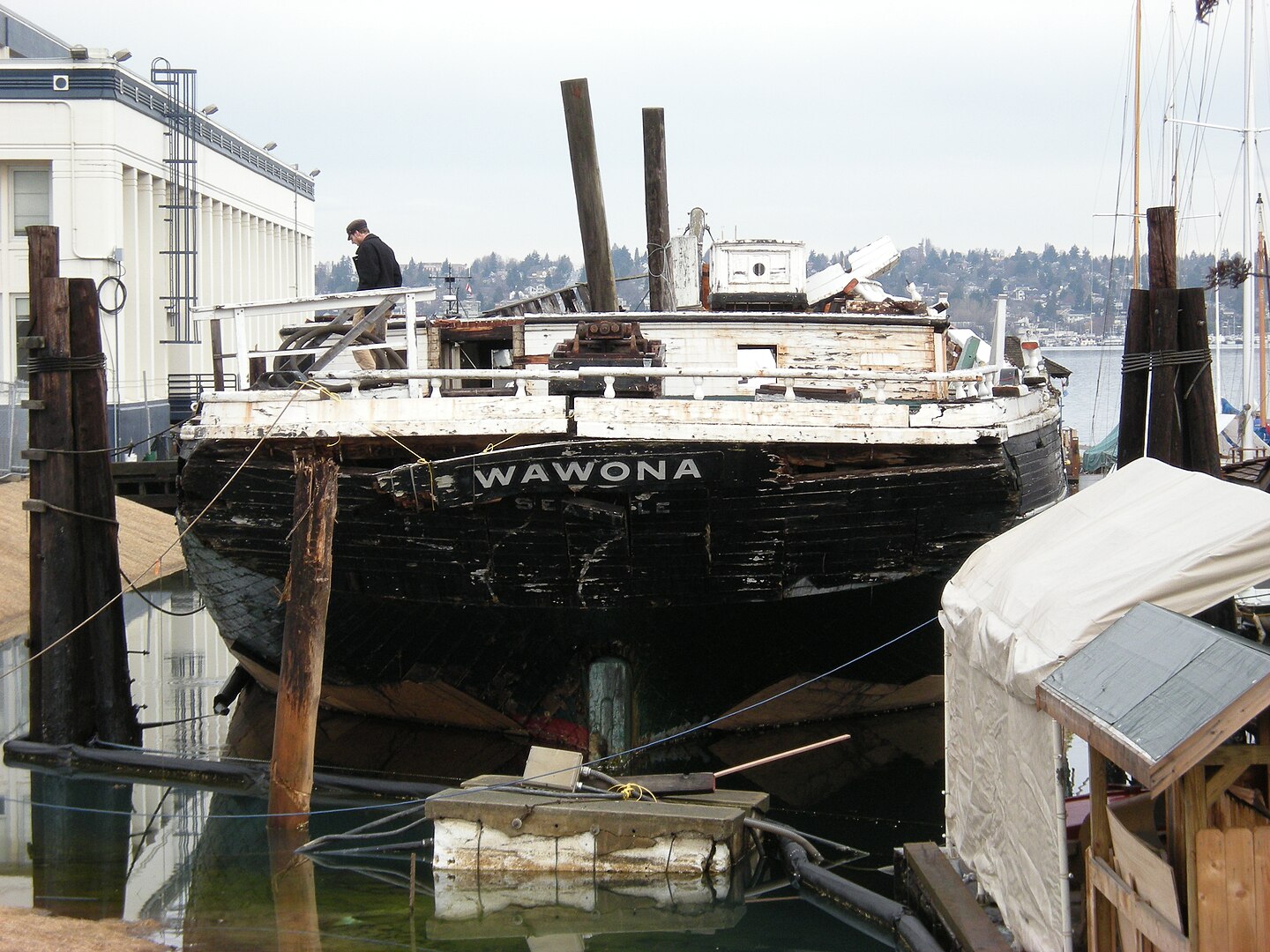
Schooner Wawona (1897-2009) – Built in Fairhaven, California by Hans Ditlev Bendixsen, Wawona was one of the largest three-masted schooners on the west coast. She served for 50 years hauling lumber to California and fishing for cod in the Bering Sea, even acting as a barge during World War II. Preserved as a museum ship in Seattle from 1964, she was ultimately dismantled in 2009 due to extensive rot. Portions of her structure were transformed into an abstract sculpture at Seattle’s Museum of History and Industry.

Frequently asked questions
Why is it so hard to preserve ships?
Vessels built for the open ocean are among the largest historical artifacts any museum or non-profit can own. For example, the battleship USS New Jersey is 887 feet long with a beam of 102 feet. That’s a lot of boat. Wooden ships are especially difficult; Water, in the form of rain, fresh water lakes, or sea water, dissolves wood over time, usually in the form of fungal rot. These are expensive repairs, often costing millions of dollars. Only the most well-heeled museum or donor can afford to keep these artifacts in good shape.
What if I want to donate my boat to a museum?
If your boat has a strong history, such as design by a famous architect, or it participated in an historic event, approach your local maritime museum and tell them what you have. That said, you should also consider offering a small endowment to keep the boat in good shape, or to pay for moorage or an educational program. Museums will say no if the board feels someone is simply trying to get rid of a problem in a cheap way.
What can I do to help preserve my favorite historic ship?
Buy a membership in a museum. Small museums, in particular, struggle with funds to pay for basic needs, such as the power bill or moorage for their historic vessel. Many museums offer benefits that create a nice return-on-investment for you. Consider other standard methods for donation, such as tax-deductible check, a portion of your estate, or naming the museum as a beneficiary of a financial instrument. And when a crisis occurs, be ready to write letters, send emails, and visit big donors and elected officials to ask for relief.
Archive: 2011 Most Endangered Historic Ships | 2012 Most Endangered Historic Ships
11 responses to “Lost museum ships: 16 historic vessels lost in the 21st century”
[…] and that boat, C.A. Thayer, is now preserved in San Francisco. I wrote my Wawona book in part to preserve her stories, because I knew the ship itself was in grave danger. My fears were borne out, and I owe Dave a debt […]
[…] most moving museum ship experience was aboard the World War II Liberty Ship, Jeremiah O’Brien. As we were steaming out of San […]
[…] Kingfisher will be displayed at Pacific Maritime & Heritage Center in Newport, Ore. Prior to demolition, the exterior of the boat was scanned using 3D laser technology, which created an exact record that […]
Where did you find the 63’ Crashboat was scrapped in 2025. I read it was scrapped sooner. Also still trying to find what season and episode of Hawaii Five-O the boat was in. Also better photos
Looks like an error on my part. I thought I read 2025, but I can’t find the reference. That said, I can’t find any info on its ultimate disposal. Here’s a link to an article in the Honolulu Star-Bulletin: https://archives.starbulletin.com/2001/05/23/news/story6.html
[…] the historic schooner Wawona. I published a history of the ship in 2006, three years before she was broken up on Seattle’s Lake Union, 112 years after she was launched in Eureka, […]
[…] of Sail. The coolest thing about these big ships is the stories. Without them as a platform, the stories will disappear into the sub-basements of libraries, or unvisited recesses of obsolete Kindles. Here’s hoping […]
[…] Rick Spilman’s fine first novel, Hell Around the Horn, I learned that the replica tall ship HMS Bounty was lost on October 29 in Hurricane Sandy, along with two of her crew. As I read the terror-filled […]
[…] The book discusses the building of jetties to stabilize the shipping channel, the adventures and tragedies of the bar pilots and their operators, and finally the equipment used by the pilots to transfer to […]
[…] Lakes shipwrecks are among the best preserved in the world. Lake Huron’s cold, freshwater has kept many Thunder Bay sites virtually […]
[…] though it converted one of the unfinished Yamato-class ships to an aircraft carrier, only to see it sunk before it was sent into battle. And ironically, the weapons on which they spent so much money and […]