
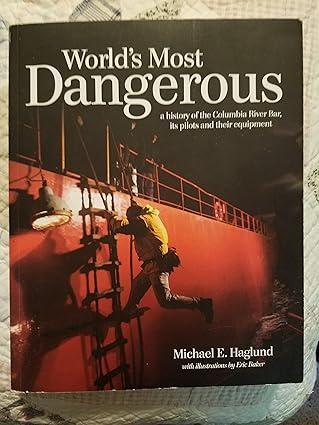
The book “World’s Most Dangerous” documents the perilous Columbia River Bar and the courageous pilots navigating its treacherous waters.
Seafarers have called the Columbia River Bar, located at the mouth of Columbia River in the Pacific Northwest, “the world’s most dangerous passage” for more than 200 years. Today, the city of Astoria, Ore., is the home of an elite group of bar pilots. Author Michael E. Haglund and illustrator Eric Baker have combined stories of the bar with tales of dedication and courage from its pilots in a new book, World’s Most Dangerous, published by the Columbia River Maritime Museum.
The book starts with the natural history of the Columbia River Bar and its formation during the cataclysmic Missoula floods 15,000 years ago. The book discusses the building of jetties to stabilize the shipping channel, the adventures and tragedies of the bar pilots and their operators, and finally the equipment used by the pilots to transfer to and from great ocean-going ships.
Human story at the core
But it’s the human story that forms the core of the book. Nowhere in America are the standards higher for a maritime pilot’s license than the Columbia River Bar. The long history of dedication of the Columbia River Bar Pilots providing service in extraordinarily dangerous conditions is exemplified in Capt. George Flavel’s efforts to save the steamer “General Warren” in 1852. As he left the stricken ship stuck in the sands of Clatsop Spit to summon help, the ship captain called out “Pilot, you will come back?” Flavel shouted, “If I live, I will return.” He did, only to find that all hands had perished.
To purchase the book, contact Columbia River Maritime Museum. Find more reviews of maritime history books on my Reviews page.