
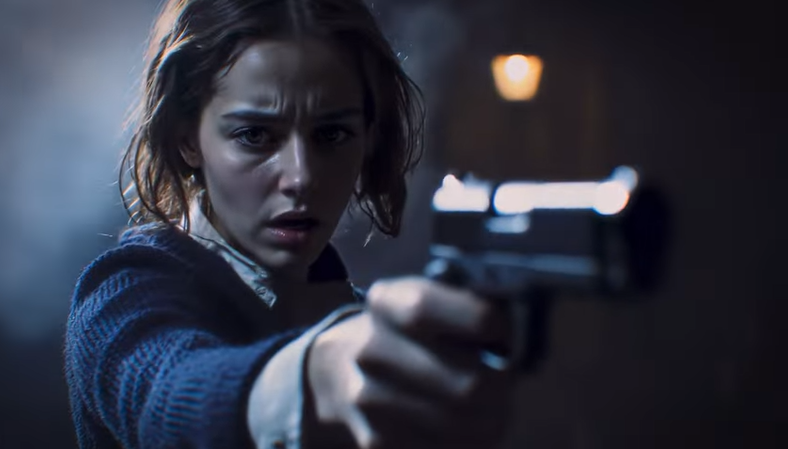
A new Hollywood venture, Staircase Studios AI, aims to release up to 30 feature-length films, including its first effort, The Woman with Red Hair.
Hollywood has tiptoed into the world of generative AI, and it’s already generated controversy. The Brutalist, nominated for a Best Picture Academy Award this year, caught flak for using AI to make its actors’ Hungarian accents more “authentic.” But so far, AI has only been used around the edges, for just brief shots or for poster art. (I’ve been using AI myself in several ways.)
Staircase Studios AI appears poised to dive into the deep end of AI filmmaking. Founded by Pouya Shahbazian, producer of the Divergent franchise, and supported by a slate of experienced managers and investors, the studio plans up to 30 projects using a “proprietary AI workflow” called “ForwardMotion.” Details are scant, but Staircase says the process results in high-quality feature-length movies with budgets under $500,000. Numerous small indie filmmakers have tried their hand at feature-length AI films, but Staircase is among the first actually trying to make a business of it.
Generative AI’s flexibility
As I see it, the low budgets (for Hollywood, at least) are an attempt to take advantage of generative AI’s flexibility without the need for on-screen talent, often the biggest line item in most films. The company promises to hire union talent for voice work and “many” technical roles. It also plans to source its AI video “ethically,” which probably means licensing deals with visual media companies, such as Getty, or building its own library of images for training AI models.
“I’ve borne witness to far too much inefficiency [in the film business] to continue the status quo,” Shahbazian said, adding that he wants to “make the kinds of films that the industry actually wants but lacks the risk tolerance to currently greenlight.”
With its announcement on March 4, the company released a sizzle reel with the first five minutes of its first feature, The Woman with Red Hair. Directed by Brett Stuart from Michael Schatz’s 2016 Black List script, The Woman with Red Hair tells the true story of Johanna “Hannie” Schaft, a college dropout who joined the Dutch resistance during World War II. The behind-the-scenes story and the movie’s sample shots show the early promise and the current limitations of AI as a filmmaking tool.
A believable, consistent main character
The team clearly worked hard at creating a believable, consistent main character in Hannie Schaft. Based on an original design by Pixar alum Teddy Newton, Hannie comes across as optimistic, ambitious, and naive, hinting at the change coming as a result of her wartime experiences. She is perhaps a little too bright-eyed, too perky. AI video’s tendencies toward too-sharp edges in photorealistic modeling make her feel more like an animation than a “realistic” character. I can only imagine the dozens or perhaps hundreds of generations before the production team got what they wanted.
The individual shots are nicely rendered with consistent (most of the time) color and lighting, something very difficult to achieve in AI video. The video has few noticeable artifacts or missteps, such as the dreaded sixth finger, but there’s a few worth pointing out. A shot of an enormous flag hung over a building appears to be layered on to another shot of a period structure; the lighting doesn’t match, and the flag’s movements are off. And a bicycle rolling over a cobbled street barely bounces; early bicycles weren’t called “bone-shakers” for nothing.
The irony of using voice actors
It’s telling that footage of the voice actors recording dialog show them with much more believable facial expressions than the AI characters. Because the voicing is dubbed, as in true animation, rather than recorded on-site and re-recorded in the studio, Hannie’s mouth movements don’t always match the sounds. (Why Staircase uses human actors rather than AI voices is unclear.) Unfortunately, Staircase hasn’t shared its tools or prompts, which is fast becoming a tradition in the indie AI video space. Perhaps some friendly criticism could improve their workflow.
It’s unclear whether Director Stuart is going for a realistic look similar to a conventional historical drama, or whether he’s going right to the edge of the uncanny valley, knowing that AI video still can’t approach the verisimilitude of film or even digital recording. That said, The Woman with Red Hair could stand out as an amazing technical achievement, even if the characters aren’t quite there yet.
What do you think? Will AI video save a broken Hollywood business model?
4 responses to “Can AI Make a Blockbuster? Staircase Studios’ Plan for $500K Feature Films”
Two gripes:
— The hairstyles of the two main women characters are all wrong. They look like they stepped out of a contemporary magazine ad. That’s not how women of that era wore their hair. Some of the background women characters’ hair is OK, but those two are a big fail.
— Why is the headline of the newspaper in the last shot in English, when the rest of the newspaper appears to be in Dutch or some other language.
Interesting about the hairstyles. Historical accuracy will be important for these films to gain traction. I saw the problem with text as well, and it’s a bad one. Generative AI has a hard time with text in general, especially blocks of text. The producers will have to find a way around this, if they expect any credibility.
So usually there are few limitations because of the context length the videos are shorter ,sometimes it can be chained but overall context length is small for everyone except google they cracked the context length game. For the motion to be controlled they need a pose controlnet , depth control net ,for the face expressions only kling seems to have done a good job with act one .
That context is probably is the reason for the shorter clips, also as you said they might be using multiple generations hoping it might it right jn fewer generations.
They prefer using backside of the character and characters speaking offscreen. They probably don’t have a pose controlnet otherwise the body movements won’t be so conservative.
The ai look is probably overbaked training commonly seen in flux and omnigen(nvidia)to some extent. There is so much b-roll filler in it , as it’s easier to generate and you don’t really care how or who drinks beer .
Usually if they have forward motion model or whatever usually people publish a paper and keep the model private. They probably have a pipeline made by vfx and ai early adopters. Like omnihuman byte(open paper +closed source )dance looks promising but I don’t think it has face control.
the humans face isn’t consistent , like it changes so much in one shot . Everyone of the young girls looks the same i cannot tell them apart if I look down.
right now opensource ones that can run on our own hardware there aren’t much , except for something that might feel like a motion comic when stitched together. Let’s hope we get more tools
Thanks for the great comments! I don’t think we have to worry about getting more tools. 🙂 The space is already getting crowded.